








Vegan Pastry: Beyond the Trend, Towards Mastery
Vegan Pastry: Beyond the Trend, Towards Mastery
- Culinary Arts
- Hospitality Industry Trends
Vegan Pastry: Beyond the Trend, Towards Mastery
Published on 09/16/2026 — Written by Luc Debove, Director of the École Nationale Supérieure de Pâtisserie (ENSP) and Meilleur Ouvrier de France
Just a few years ago, plant-based pastry could still be seen as a niche, primarily catering to the expectations of vegan consumers. That is no longer the case today.
In France, sales across five major categories of plant-based alternatives reached €572 million in 2025, up 21% compared with 2023. This momentum extends far beyond consumers who have completely excluded animal products from their diets.
The shift is equally visible in the bakery and pastry sector. According to Innova Market Insights, 21% of new products launched in the global bakery sector carried a plant-based claim, with cakes, pastries and other sweet products among the leading areas of innovation.
However, I believe it would be reductive to describe this simply as a “vegan trend”. What we are witnessing today goes deeper: plant-based pastry is becoming a new field of technical and creative expression for pastry chefs.
Removing butter and eggs is not enough
Pastry has historically relied on a number of ingredients whose technical properties are fundamental: eggs provide structure and emulsification; butter contributes texture, richness and flavour; cream provides smoothness and stability.
Simply removing them from an existing recipe and attempting to replace them mechanically rarely produces the desired result.
This is precisely where plant-based pastry becomes particularly interesting for our profession. It forces us to return to the very function of each ingredient. Why are we using an egg in this preparation? Are we looking for its binding, emulsifying or aerating properties? What texture are we trying to achieve? What role does the fat play?
The pastry chef must then learn to use the properties of fruits, cereals, seeds, nuts, plant proteins and natural gelling agents differently.
Plant-based pastry is therefore not traditional pastry with certain ingredients removed. It is a technical language that must be learned and mastered.
Taste must remain the ultimate judge
This evolution will only succeed, however, if we avoid one major pitfall: assuming that being plant-based is enough to make a good product.
Consumers are not willing to make that compromise. Innova studies show that taste remains the leading challenge for plant-based products in the bakery and pastry sector, while more than 60% of consumers rank taste among their priorities when purchasing sweet products.
This is an essential point for professionals. A customer may choose a dessert because it is plant-based, but they will come back because it tastes good.
Our responsibility as pastry chefs therefore remains exactly the same: to create emotion. A mousse must be light and airy, a ganache smooth, puff pastry crisp and an entremets perfectly balanced. Plant-based pastry should never become an excuse for accepting an inferior result.
On the contrary, this constraint can become a powerful driver of creativity.
Moving beyond substitution to create differently
We are also seeing an interesting evolution in the market. After several years largely focused on replicating animal-based products, consumers are increasingly looking for greater naturality and recognisable plant-based ingredients. Innova reports that 55% of consumers surveyed believe plant-based products should stand in their own right rather than simply seeking to imitate their animal-based equivalents.
For pastry, this represents an opportunity.
Why systematically seek to reproduce a traditional cream or mousse identically? Plant-based ingredients can lead us towards new textures, new balances and new flavour combinations.
This also reflects a broader transformation taking place in contemporary pastry: desserts that are less saturated with sugar and place greater emphasis on the product itself, fruit, seasonality and clearly defined flavours.
The question is therefore no longer simply: “What can we use to replace butter or eggs?” It becomes: “What kind of dessert can we imagine thanks to this new palette of ingredients?” To me, that shift in perspective is far more exciting.
Equipping pastry chefs with an additional skill set
For culinary schools, this evolution also comes with a responsibility.
The objective is not to train “traditional” pastry chefs on one side and “vegan” pastry chefs on the other. We need to train professionals who understand both approaches and are able to choose the one best suited to their creation, establishment and clientele.
At ENSP, we already integrate plant-based pastry at different levels of our teaching. Its development responds to a very practical reality of the profession: whether working in a luxury hotel, fine-dining restaurant, pastry boutique or internationally, tomorrow’s pastry chefs will need to be able to offer plant-based creations with the same standards of quality and excellence as the rest of their menu.
This is why training cannot stop at learning a few recipes. It must encompass ingredient technology, substitution mechanisms, aeration, emulsification, gelling, fermentation and the behaviour of plant-based fats. It is this understanding that ultimately gives professionals the freedom to create.
French pastry has always evolved in this way: by embracing new ingredients, new techniques and new expectations without abandoning its fundamentals.
Vegan pastry will not replace traditional pastry, nor is that its purpose. Instead, it enriches the pastry chef’s vocabulary. It is now our responsibility to ensure that this new vocabulary is mastered with the same precision, indulgence and exacting standards as those we have been passing on for generations.
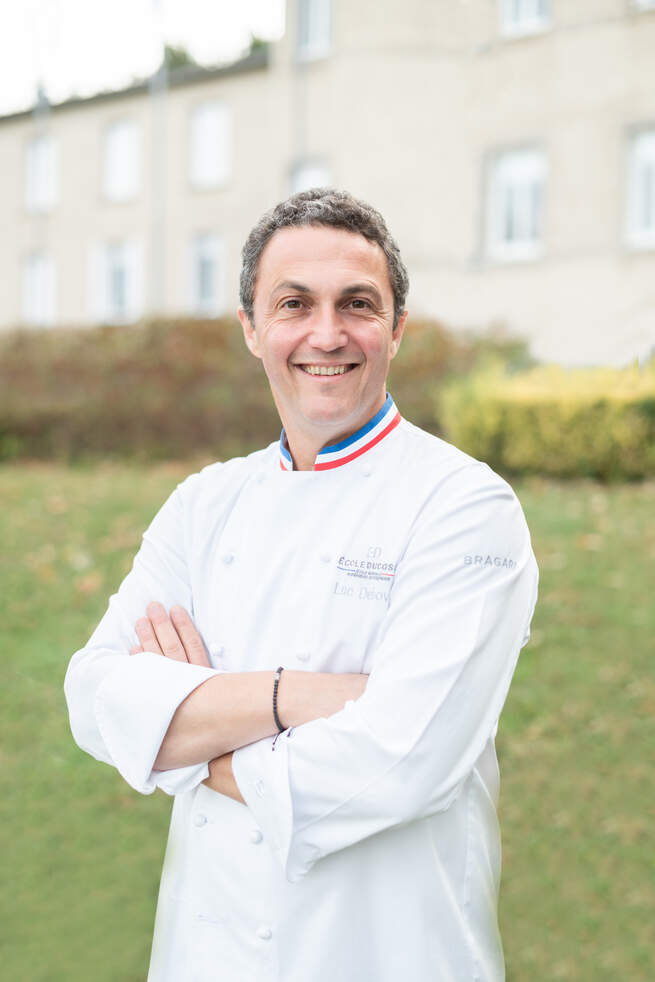
About the author
Luc Debove, Director of the École Nationale Supérieure de Pâtisserie (ENSP) and Meilleur Ouvrier de France.

Continue Your Hospitality Journey
Looking for more inspiration? Discover expert insights, student stories, industry trends, and career stories on École Ducasse.
Discover École Ducasse Blog